Business relocation to Texas is not just about finding land, incentives, or a lower-cost operating environment—it is about finding the workforce and educational partners that can help a company grow after the ribbon-cutting. In this episode, Alan Clipperton of LeTourneau University explains how East Texas industry is being supported through technical education, senior design projects, applied learning, robotics, aviation, welding engineering, and hands-on workforce development. For business owners sorting through the noise of Texas options, Kilgore and the Upper East Texas region offer a Texas-sized solution: a practical, relationship-driven ecosystem where companies, educators, and economic developers work side by side.
Source Link: Listen to the full episode on GoneToTexasPodcast.com to hear Alan Clipperton’s full conversation with Super Dave Quinn.
Relocating a business is never just a business decision.
For a CEO, founder, or family-owned manufacturer, the move affects your balance sheet, employees, customers, suppliers, and the people at your dinner table. Texas offers more than 1,200 communities, regions, and local options to consider, which can make the opportunity feel exciting and overwhelming at the same time.
That is why the best relocation decisions are not made by chasing headlines. They are made by finding the right local ecosystem.
In this episode of Gone to Texas, sponsored by Kilgore Economic Development Corporation, Alan Clipperton, Vice President for Global Initiatives and Industry Engagement at LeTourneau University, gives business leaders a look at one of East Texas’ strongest competitive advantages: a university built on technical education, practical problem-solving, and direct industry engagement.
For companies considering business relocation, expansion, workforce strategy, or site selection in Texas, Alan’s message is clear: the future belongs to regions where education and industry move together.
Business Relocation Insight #1: East Texas Is Building More Than a Workforce—It Is Building Problem-Solvers
Many communities talk about the workforce. Fewer can point to a university partner that is actively helping companies solve technical problems, train employees, and develop future engineers.
LeTourneau University’s roots go back to 1946, when it was founded as LeTourneau Technical Institute to train returning World War II veterans in practical trades. That legacy still matters today.
Alan explained that LeTourneau supports industry through three primary pathways:
1. Education and Technical Training
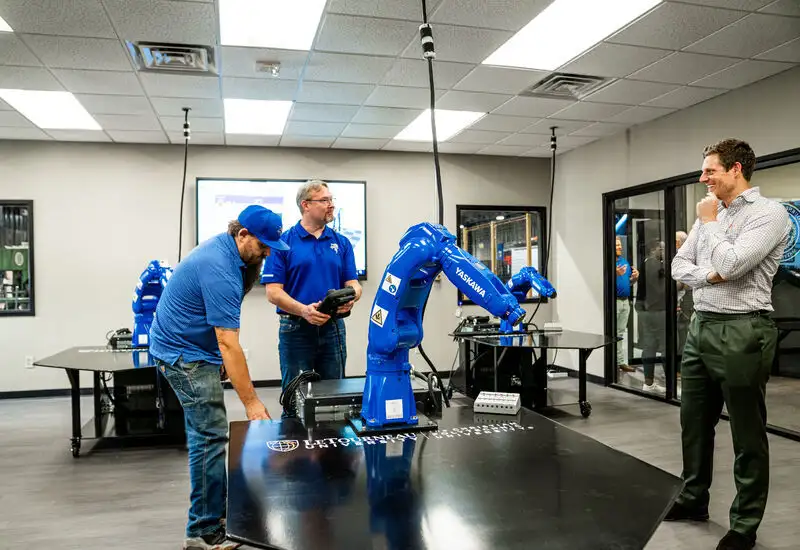
Companies can work with LeTourneau on workshops, certificate programs, degree programs, and targeted technical education. One standout example is the Yaskawa welding robotics lab, where companies can explore automation, robotic welding, and materials handling.
For East Texas manufacturers, this is more than a classroom asset. It is a site selection asset.
A company considering automation does not have to guess on its own. It can put people in a lab, understand the technology, and evaluate whether robotics makes sense for its operation.
2. Senior Design Projects
Companies with engineering problems can sponsor senior design projects, allowing LeTourneau engineering students and faculty to design, build, and test real-world solutions.
Alan was clear that this is not the same as hiring a consulting firm. It is an educational process with a defined scope and timeline. But for the right project, it gives companies access to creative technical talent while giving students meaningful industry experience.
3. Applied Learning Projects
For projects that do not fit the senior design model, LeTourneau can structure applied learning projects. Alan cited examples such as CAD drafting, failure analysis, non-destructive testing, robotic welding procedures, and other technical assignments.
That matters for small and mid-sized companies because it creates a practical way to get work done without immediately hiring a full-time engineer or outside consultant.
“Trying to reduce the cost for the employer, for the industry, local industry, but also it benefits us in a tremendous way because our students get that practical application of their skills.”
That is the kind of workforce development that turns education into economic development.
Site Selection Insight #2: Kilgore’s Advantage Is Not Just Location—It Is Alignment
Kilgore already offers many of the core factors companies look for in a Texas site selection process: transportation access, low taxes, competitive utility rates, available sites, and a business-friendly economic development team.
The episode also highlights something more strategic: alignment.
LeTourneau University, Kilgore EDC, Longview-area partners, and regional employers are increasingly working in parallel. Alan described a shift toward shared planning, deeper relationships, and a more intentional connection between the university and local economic development organizations.
For a business owner evaluating East Texas, that alignment can reduce risk.
When a company lands in a community, the first question is rarely, “Can I get through the announcement?” The real question is, “Can I operate, hire, train, innovate, and scale here three years from now?”
Alan put it plainly:
“I think there’s a massive opportunity for us as an institution to lean into that even further and be more of a blessing to the industries that are here and be part of the reason why industries come here to this area.”
That is a powerful statement for a business relocation strategy. East Texas is not just recruiting companies. It is building the support system that those companies need after they arrive.
Texas Economy Insight #3: Technical Education Is Becoming a Competitive Advantage in the AI and Automation Era
Alan made one of the episode’s most important points when he said that companies can no longer plan 10 years out with confidence.
“I don’t think we can plan that far out anymore. It’s next year or three years from now at max.”
That line should get the attention of every CEO and site selector.
The Texas economy is changing fast. Automation, AI, robotics, advanced manufacturing, semiconductors, aerospace, aviation, welding engineering, and personalized education are all reshaping the way companies think about talent.
Alan’s view is not that technology replaces workforce development. It changes what workforce development must become.
LeTourneau is asking the same questions the industry is asking:
How do we train people to use AI responsibly?
Businesses are not just looking for employees who can push buttons. They need people who can think critically, evaluate information, and use emerging tools responsibly and ethically.
How do we prepare students for industries that are changing every year?
Alan connected this directly to higher education, online learning, dual credit, and personalization. The future of education may need to become more tailored to the learner, just as products and services are becoming more personalized to the customer.
How do we help companies adapt before they fall behind?
For business owners, this is the real issue. Your competitors are learning new tools. Your suppliers are changing. Your customers are expecting faster answers. A region with technical education partners who are asking future-facing questions gives companies a better shot at staying competitive.
Economic Development Insight #4: Workforce Development Starts With Character, Not Just Credentials
One of the most distinctive parts of the conversation was Alan’s emphasis on work ethic, purpose, and character.
LeTourneau is a faith-based university, and Alan explained that the university is intentional about preparing students with more than hard skills. The goal is to graduate students with integrity, honor, respect, and a sense of mission.
For employers, that matters.
Technical skills can be taught. The harder thing to find is someone who shows up with drive, humility, curiosity, and the ability to keep learning.
Alan shared a story from his childhood working in his father’s auto repair shop in Minnesota. At the time, he disliked sweeping floors, sorting bolts, and working with his hands. Looking back, he described those experiences as formative.
That story led to one of the episode’s most practical workforce lessons: the right person with the right motivation can learn almost anything.
In a tight labor market, that mindset can be a major advantage for East Texas employers.
East Texas Site Selection Insight #5: Companies Need a Front Door Into the Talent Ecosystem
For business owners wondering how to plug into LeTourneau’s resources, Alan’s answer was refreshingly direct: start with a conversation.
He said he likes visiting plants, walking the floor, talking with owners and managers, and understanding what a company is trying to solve. Sometimes the answer might be an intern. Sometimes it might be a student project. Sometimes it might require a more robust proposal.
That “front door” matters.
Many business owners have had frustrating experiences with institutions that move too slowly or deliver solutions long after the problem has changed. Alan acknowledged that timelines vary by project, but he also explained that applied learning proposals often move much faster than traditional academic timelines.
For example, he noted that some companies send failure analysis work to outside labs and wait weeks or months for results. LeTourneau has a scanning electron microscope used primarily for education. Still, in the right situation, students and faculty can use that equipment to support industry needs and return analysis in a shorter window.
That is exactly the type of local capability that can make a region more competitive for manufacturing and technical operations.
What This Means for Companies Considering Kilgore, Longview, and Upper East Texas
For companies evaluating Texas, East Texas deserves a serious look because the region is combining several relocation fundamentals:
Operational Advantage
Kilgore offers transportation access, competitive utilities, low taxes, and available industrial sites, including Synergy Park, a Class A campus-style business park.
Workforce Support
LeTourneau University, Kilgore College, Texas State Technical College, and other regional partners create a layered workforce ecosystem that can support technical, engineering, aviation, welding, manufacturing, and applied learning needs.
Industry Relevance
Alan specifically referenced robotics, welding, aviation, engineering, electronic testing, semiconductor testing, failure analysis, CAD drafting, and non-destructive testing. Those capabilities line up with several of Texas’ strongest growth sectors, including advanced manufacturing, aerospace, aviation, energy, automation, and technology.
Human Connection
Perhaps most importantly, the episode reveals a relationship-driven culture. In Alan’s words, LeTourneau is not a massive institution that treats industry like a transaction. It values personal relationships and practical collaboration.
For a stressed CEO trying to choose the right Texas community, that kind of boots-on-the-ground connection can make the difference between a hard landing and a soft one.
Gold Nugget Quotes From Alan Clipperton
“Trying to reduce the cost for the employer, for the industry, local industry, but also it benefits us in a tremendous way because our students get that practical application of their skills.”
“I think there’s a massive opportunity for us as an institution to lean into that even further and be more of a blessing to the industries that are here and be part of the reason why industries come here to this area.”
“I don’t think we can plan that far out anymore. It’s next year or three years from now at max.”
Resources Mentioned in This Episode
- LeTourneau University
- Kilgore Economic Development Corporation
- RG Research and Development / RG R&D
- Yaskawa welding robotics lab
- Synergy Park
- Kilgore College
- Texas State Technical College
- GoneToTexasPodcast.com
- Texas Economic Development Connection
- TexasEDConnection / texasconnection.com
- FAA
- YouTube
- AI tools
- Chilton manuals
- Mitchell manuals
- Scanning electron microscope
- Senior design projects
- Applied learning projects
- Welding robotics certificate program
- Aviation programs
- Airframe and Powerplant certification
- Commercial pilot training
- Aircraft dispatch
- Drone technology
- Aeronautical engineering technology
- Welding engineering
- Electronic testing and semiconductor testing certification concepts
The Bigger Texas Takeaway
Alan Clipperton’s story is not just about one university. It is about what happens when a region treats workforce development as a long-term economic development strategy.
For companies considering relocating to Texas, the smartest move is not always the largest metro area or the loudest incentive package. Sometimes the best move is the community where education, industry, and economic development are already sitting at the same table.
Alan’s work with LeTourneau University shows how East Texas companies can find the kind of technical talent, hands-on problem-solving, and relationship-driven support that creates a true soft landing—and TexasEDConnection’s Free Personal Concierge helps business owners find that same kind of success story without sorting through the noise alone.
Ready to make your move? Book a Site Selection Consultation with TexasEDConnection.