

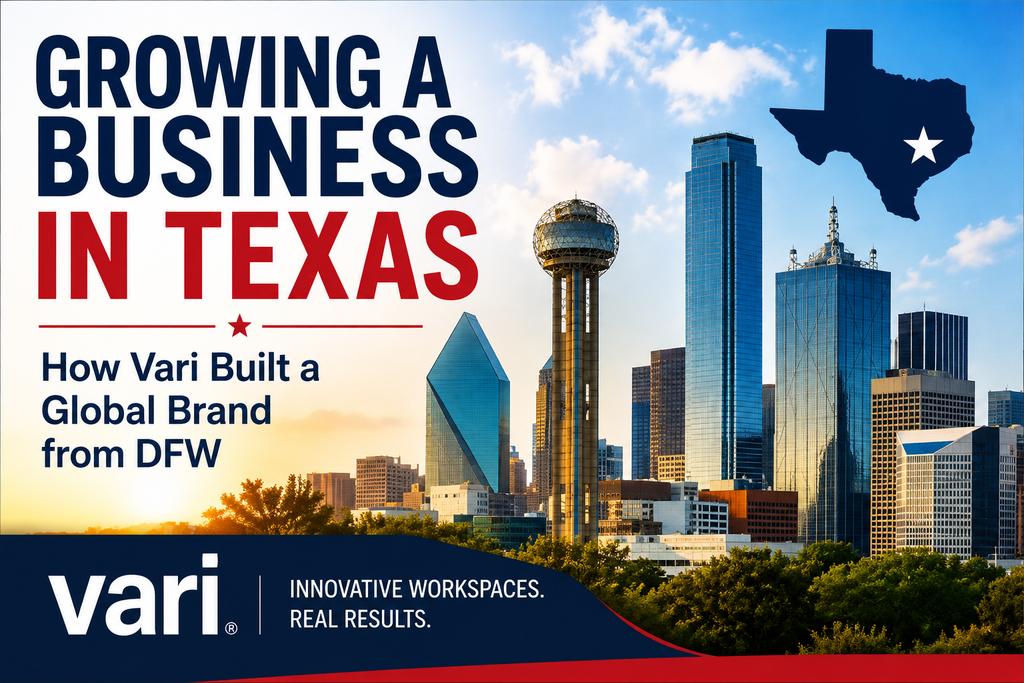
Growing a Business in Texas: How Vari Built a Global Brand from DFW
Growing a business in Texas gives companies access to the customers, talent and connections that can fuel Texas business growth. For Jason McCann, co-founder and CEO of Vari, North Texas provided an environment where an idea could be tested, improved and ultimately turned into a global business.
Vari began with a deceptively simple problem. McCann’s business partner was experiencing back pain and wanted to stand more while working. When he couldn’t find the right standing desk solution, the two entrepreneurs began exploring whether they could create something better.
That experiment eventually became VariDesk and later Vari, a workspace innovation company headquartered in North Texas.
But Vari’s story isn’t simply about creating a successful product. It also demonstrates how growing a business in Texas can mean using the customers, talent, infrastructure and business community around you as part of your growth strategy.
Start With a Problem Worth Solving
Vari didn’t begin with an elaborate plan to reinvent the workplace. Instead, it began with a cardboard box.
McCann’s business partner, Dan, had been advised to stand more because of back pain. Unable to find the standing desk solution he wanted, the team began experimenting with a product that could sit on top of an existing desk and allow someone to move between sitting and standing.
First, they built a prototype.
Then they did something every entrepreneur should remember: they got it out of the building.
McCann put the prototype in his Tahoe and began taking it to companies around DFW.
One of those early conversations was with Verizon. What started as a product demonstration became a much larger discussion about ergonomics, employee wellness and back pain in the workplace.
The potential customer began asking questions. Then came the question every entrepreneur wants to hear:
How much is it?
The marketplace was beginning to validate the idea.
DFW Became Vari’s Testing Ground
One advantage of building the company in North Texas was immediate access to other businesses.
Instead of developing its product in isolation, Vari could put prototypes in front of major employers and get real-world feedback.
The Container Store became another early customer. Meanwhile, conversations with companies throughout the Metroplex helped Vari understand what customers actually needed rather than simply guessing.
That feedback became part of the company’s innovation engine.
When customers wanted anti-fatigue mats, Vari developed them. When they wanted monitor arms, Vari created easier ways to attach them.
Later, customers asked for full electric standing desks. However, existing products could take significant time to assemble. Vari responded by designing a desk that could be assembled in minutes.
Over time, a single product became an expanding workspace solution.
That access to real customers and immediate feedback became an important part of Vari’s business growth in Texas.
For other growing companies, the lesson is important: your location isn’t simply where you operate. It can become part of how you innovate.
Being surrounded by potential customers, suppliers, advisors, talent and other entrepreneurs can give a company opportunities to test ideas faster and learn directly from the marketplace.
Listen to Customers and Keep Innovating
One theme appears repeatedly in McCann’s story: listen.
Vari’s growth wasn’t built around assuming the company already knew what the market wanted. Instead, customers helped tell them.
That philosophy continues today. McCann said Vari has hundreds of products in the marketplace and continues developing new ones based largely on customer feedback.
It’s an important distinction.
Innovation doesn’t always mean inventing something nobody has ever imagined. Sometimes it means identifying a frustrating experience and asking:
Why does it have to work this way?
Vari applied that thinking to standing desks, accessories, electric desks, workspace configurations and even the traditional office cubicle.
Again and again, the company looked for friction and tried to remove it.
For companies interested in business growth in Texas, that customer-first approach offers another lesson: proximity to customers can become a competitive advantage when a business is willing to listen.
When the Brand Outgrows the Original Product
Eventually, Vari faced a different challenge.
The name VariDesk had become synonymous with a successful product, but the company was becoming much more than desks.
According to McCann, the business had generated more than $1 billion in sales and had millions of product users around the world.
Changing a brand with that kind of recognition wasn’t a small decision. However, leadership believed the company’s future required room to grow.
Working with branding firm Landor, VariDesk became Vari — a name broad enough to represent flexibility, change, technology and an expanding vision for the workplace.
The company invested heavily in the transition, expanded its team, opened showrooms around the country and prepared for its next stage of growth.
Then came 2020.
A 48-Hour Pivot That Helped Save the Business
Vari entered 2020 positioned around the office of the future.
Then offices across the country suddenly emptied.
McCann described the experience as sailing a beautiful sailboat directly into a hurricane.
Until that point, Vari’s marketing had focused on designing, delivering and installing workspaces for companies. Almost overnight, millions of employees were working from kitchen tables, spare bedrooms and makeshift home offices.
Vari responded in approximately 48 hours.
The company’s advertising shifted from being an office-of-the-future partner to becoming a work-from-home partner.
Commercials were recut, the website offered a discount and Vari’s e-commerce operation suddenly became a critical part of the business.
McCann credits that pivot with helping save the company.
He also points to Texas as an important part of the story. Vari was able to continue operating and shipping products as demand for home-office products surged.
Rather than abandoning its core mission, the company adapted that mission to a dramatically different marketplace.
That ability to change remains central to how McCann thinks about business — and workspace itself.
Growing Companies Need Flexibility
Businesses rarely grow in a perfectly straight line.
Companies hire new employees, reorganize teams and adjust operations. Work may move between offices and homes, while new departments emerge and customer needs continue to change.
Because of that constant evolution, McCann believes workspaces should be capable of changing along with the businesses occupying them.
Walls can move, marker boards can be mobile and furniture can be reconfigured. At the same time, employees can have effective setups whether they’re working in the office or at home.
The idea is bigger than furniture.
It’s a business philosophy: build for change rather than pretending change isn’t coming.
That same philosophy helped Vari navigate its own growth.
Why Growing a Business in Texas Made a Difference
When asked what Texas offers growing companies, McCann pointed to several advantages.
Those advantages include access to capital, available workspace, business networks, entrepreneurial culture, talent and customers.
Perhaps most importantly, he described a culture that encourages people to get things done.
For Vari, DFW provided a place where the company could incubate an idea, introduce it to sophisticated businesses, gather feedback and begin building a customer base.
In other words, growing a business in Texas gave Vari an opportunity to start locally while thinking much bigger.
Then something interesting happened.
The company’s Texas location began opening doors far beyond Texas.
Vari advertised in airline publications and started hearing from prospective customers in places as far away as Australia.
McCann said the company hadn’t fully appreciated the global influence that could come from operating in DFW. With major airports, business travelers and professional networks around them, however, a company that started by testing a prototype with nearby businesses was suddenly attracting international customers.
Vari eventually began doing millions of dollars in business in Australia.
As McCann put it, a company can incubate here — and then go global.
Vari’s experience demonstrates how business growth in Texas can begin with local relationships while creating opportunities to reach customers around the world.
Texas Communities Can Be Part of a Company’s Growth Strategy
Another important lesson about growing a business in Texas is that companies don’t have to figure everything out alone.
Local chambers, economic development organizations and Texas communities can help businesses make connections, understand local markets and find resources.
That becomes especially important when a company is trying to determine where within a large region like DFW it belongs.
One company may need a particular type of employee, while another may prioritize access to customers. Likewise, a corporate headquarters may have completely different location requirements from a manufacturing operation, technology company or back-office facility.
McCann emphasized the importance of understanding the talent available within a market and matching businesses with communities where those workers live.
That’s where local knowledge matters.
For companies considering business growth in Texas, local economic development organizations can provide valuable insight into workforce, infrastructure, available properties and individual communities.
A location that looks perfect on a map may not be the best location for the people a company needs to recruit.
For expanding and relocating businesses, talking with local economic developers early can provide intelligence that isn’t always obvious from a real estate listing or online search.
Fairview: Where Community Meets Opportunity
That combination of business opportunity and quality of life is particularly relevant for communities like Fairview, Texas, the sponsor of this episode of Gone to Texas.
Located in Collin County, Fairview represents the kind of community that can appeal to entrepreneurs and growing companies looking beyond square footage alone.
That’s because business relocation isn’t only a business decision.
It’s also a human decision.
Owners may be moving their families. Employees may be deciding whether to relocate. Companies need to think about recruiting and retaining people as much as they think about buildings.
During the conversation, McCann repeatedly returned to the importance of families, schools, universities, housing, talent and community.
For a growing company, those aren’t secondary considerations.
They’re part of the location decision.
For communities across the state, attracting companies and supporting business growth in Texas means understanding both sides of that decision — what the business needs and what its people need.
The Future of Work Is Still About People
For a company built around workspace innovation, Vari has a front-row seat to the debate over what happens next.
Should companies be fully remote? Should employees return to the office five days a week? Or is hybrid work the answer?
McCann doesn’t believe there is one solution for every company.
What Vari sees most often, he said, are organizations bringing employees together in the office three to four days a week.
As a result, the purpose of the workplace itself becomes more important.
Instead of simply providing desks, workplaces need areas for concentration, collaboration, communication and culture. They also need to create opportunities for people to interact.
Despite enormous advances in technology, McCann believes there is still something irreplaceable about human connection.
The Bigger Texas Business Story
Perhaps the most interesting part of Vari’s story isn’t the standing desk at all.
It’s what happened after two entrepreneurs identified a problem.
They built something and showed it to customers. They listened to the feedback, improved the product and continued taking risks.
Along the way, they expanded the product line, changed the brand, survived a historic disruption and kept innovating.
Texas provided an environment where much of that could happen — access to companies, talent, infrastructure, business networks and communities interested in helping businesses grow.
Today, McCann sees that same energy continuing across DFW and throughout Texas, from real estate and technology to artificial intelligence, robotics, advanced manufacturing and new forms of development.
For entrepreneurs and executives considering business growth in Texas, Vari’s story offers an important takeaway.
Texas isn’t simply a place to relocate a business. It can be a place to test an idea, build a team, find customers, adapt, scale — and potentially take that business to the world.
Ready to Explore Texas?
If your company is considering relocating, expanding or growing a business in Texas, TexasEDConnection can help connect you directly with Texas communities ready to understand your needs and help you identify the right place to grow.
Whether you’re exploring a new location or planning your next stage of business growth in Texas, connecting with the right community early can help you make a more informed decision.
To hear the complete conversation with Vari co-founder and CEO Jason McCann, watch or listen to this episode of Gone to Texas, powered by Day One Experts.